Random Combat

Randomized Combat introduces chance into battles. Instead of armies always dealing a fixed amount of damage, each attacking and defending army independently rolls to determine whether it scores a kill.
By default, each attacking army has a 60% chance to kill one defending army, while each defending army has a 70% chance to kill one attacking army. The actual number of kills in any battle may be higher or lower than the average due to randomness.
The amount of randomness can be controlled with the Luck Modifier, which allows game creators to choose a value between 0% and 100%.
How Combat Works
When an attack is made, every attacking army rolls independently. Each attacking army has a 60% chance of killing one defending army.
At the same time, every defending army rolls independently. Each defending army has a 70% chance of killing one attacking army.
If all defending armies are eliminated, the territory is captured. Any surviving attacking armies move into the newly conquered territory.
If at least one defending army survives, the attack fails and all surviving attackers remain in their original territory.
If all attackers and defenders are eliminated in the same battle, one defending army is resurrected and the territory remains under the defender's control.
Expected Results
Since attackers kill an average of 60% of their number and defenders kill an average of 70% of their number, players can estimate battle outcomes before attacking.
For example:
- 10 attacking armies will kill approximately 6 defenders.
- 20 attacking armies will kill approximately 12 defenders.
- 50 attacking armies will kill approximately 30 defenders.
- 100 attacking armies will kill approximately 60 defenders.
Actual results may vary from battle to battle depending on luck.
Generally, players should attack with substantially more armies than the defender whenever possible.
Examples
Animation Example
In the animation shown in the upper-right, 7 armies attack a territory defended by 4 armies. The attacking territory originally contained 8 armies, but one army must remain behind, so only 7 may attack.
Each of the 7 attackers has a 60% chance to score a kill. Each of the 4 defenders has a 70% chance to score a kill.
In this example, the attackers kill all 4 defenders while the defenders kill 3 attackers. Since all defenders were eliminated, the territory is captured. The 4 surviving attackers move into the conquered territory.
Successful Attack Example
Suppose 15 armies attack a territory defended by 6 armies.
The attackers are expected to kill about 9 defenders, while the defenders are expected to kill about 4 or 5 attackers.
If the attackers kill all 6 defenders and lose 5 armies in return, the remaining 10 attackers capture the territory.
Failed Attack Example
Suppose 25 armies attack a territory defended by 20 armies.
The attackers are expected to kill about 15 defenders, while the defenders are expected to kill about 14 attackers.
If 15 defenders and 15 attackers are killed, 5 defenders remain alive. Since defenders survived, the territory is not captured and the surviving attackers return to their original territory.
Luck Modifier
The Luck Modifier determines how strongly random rolls affect combat results.
When a battle occurs, War.app calculates two values:
- The expected result, based on average kill rates.
- The random result, based on the actual combat rolls.
The final result is then interpolated between these values according to the Luck Modifier setting.
100% Luck
At 100% luck, the game uses the fully randomized result.
For example, if 100 attacking armies are expected to kill 60 defenders but the random rolls produce only 54 kills, the game uses 54.
50% Luck
At 50% luck, the game averages the expected and random results.
Using the same example:
- Expected kills: 60
- Random kills: 54
The final result becomes 57 kills.
0% Luck
At 0% luck, all randomness is removed.
Using the same example, the game always uses the expected result of 60 kills regardless of the random rolls.
This produces the deterministic combat system described in Basic Combat.
Luck Analysis
The graph below illustrates how lower luck percentages reduce the spread of possible combat outcomes and make results more predictable.
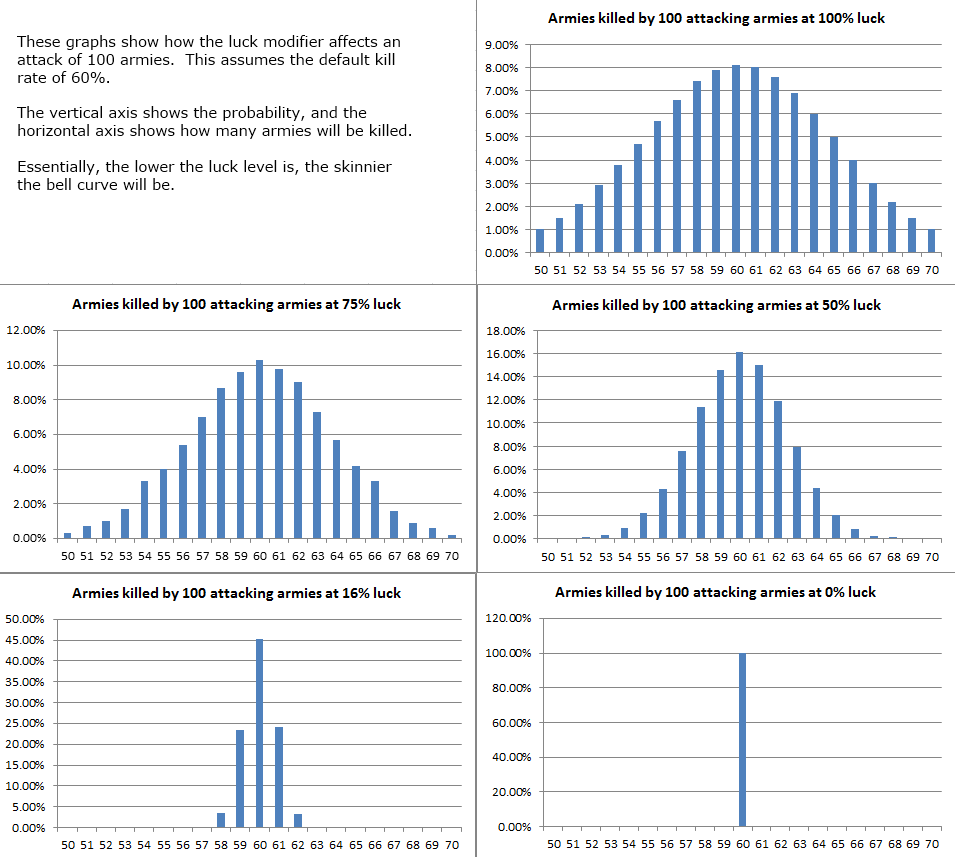
As the Luck Modifier approaches 0%, battle outcomes become increasingly consistent. As it approaches 100%, battle outcomes become increasingly dependent on random rolls.
Analyze Graphs
War.app provides Analyze Graphs, a tool that calculates the probability of attacks succeeding under the current game settings.
This tool automatically accounts for the Luck Modifier, kill rates, and other combat settings, making it useful for evaluating attacks before committing armies.
Related Settings
Rounding Mode
Combat calculations do not always produce whole numbers. When fractional kills occur, the Rounding Mode setting determines how those fractions are handled.
Selecting Weighted Random instead of Straight Round can affect the number of armies required to successfully capture territories.
Overridden Kill Rates
The default offense and defense kill rates are 60% and 70%, respectively. However, game creators may customize these values through Offense and Defense Kill Rates.
Always verify the game settings if you are unsure which kill rates are being used.